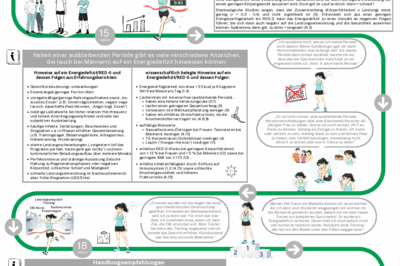

Dünn = schnell? Folgen von RED-S im Lauf: Einzelfall trifft Evidenz
RED-S steht für relatives Energiedefizit im Sport und ist begründet in einer ausgeprägten und/oder anhaltenden, geringen Energieverfügbarkeit (1). Im Mittel-/ Langstreckenlauf liegt die Prävalenz einer zu geringen Energieverfügbarkeit bei 18-58 % und im Durchschnitt bei 43,4 % (2,3). Geht dies mit hormonellen und/oder gesundheitlichen Verschiebungen einher, spricht man von RED-S. Bei Läufern wurde eine RED-S-Prävalenz von 50 % und für Läuferinnen von 57 % ermittelt (4). Die Entwicklung von RED-S ist dabei vielfältig und geht nicht zwingend mit einer Essstörung einher. Gefährlich wird es, wenn die eigene Entwicklung mit einem geringen Körpergewicht assoziiert wird. Doch gilt im Lauf wirklich: dünn = schnell? Diesbezügliche Studien zeigen, dass der Zusammenhang (Körperfettanteil x Leistung) meist gering (r = 0,2 - 0,4) und nicht signifikant ist (5). Entwickelt sich aus einer geringen Energieverfügbarkeit ein RED-S, kann das Energiedefizit zu einer Vielzahl an negativen Folgen führen, die sich dann auch negativ auf die Leistungsentwicklung und die Gesundheit auswirken können. Spätestens dann gilt: zu dünn = langsam! (6,2)
Stand: 05/2026
- Mountjoy, M., Ackerman, K. E., Bailey, D. M., Burke, L. M., Constantini, N., Hackney, A. C., Heikura, I. A., Melin, A., Pensgaard, A. M., Stellingwerff, T., Sundgot-Borgen, J. K., Torstveit, M. K., Jacobsen, A. U., Verhagen, E., Budgett, R., Engebretsen, L., & Erdener, U. (2023). 2023 International Olympic Committee's (IOC) consensus statement on Relative Energy Deficiency in Sport (REDs). British journal of sports medicine, 57(17), 1073–1097. https://doi.org/10.1136/bjsports-2023-106994
- Gallant, T. L., Ong, L. F., Wong, L., Sparks, M., Wilson, E., Puglisi, J. L., & Gerriets, V. A. (2025). Low Energy Availability and Relative Energy Deficiency in Sport: A Systematic Review and Meta-analysis. Sports medicine (Auckland, N.Z.), 55(2), 325–339. https://doi.org/10.1007/s40279-024-02130-0
- Melin, A. K., Heikura, I. A., Tenforde, A., & Mountjoy, M. (2019). Energy Availability in Athletics: Health, Performance, and Physique. International journal of sport nutrition and exercise metabolism, 29(2), 152–164. https://doi.org/10.1123/ijsnem.2018-0201
- Heikura, I. A., Uusitalo, A. L. T., Stellingwerff, T., Bergland, D., Mero, A. A., & Burke, L. M. (2018). Low Energy Availability Is Difficult to Assess but Outcomes Have Large Impact on Bone Injury Rates in Elite Distance Athletes. International journal of sport nutrition and exercise metabolism, 28(4), 403–411. https://doi.org/10.1123/ijsnem.2017-0313
- Arrese, A. L., & Ostáriz, E. S. (2006). Skinfold thicknesses associated with distance running performance in highly trained runners. Journal of sports sciences, 24(1), 69–76. https://doi.org/10.1080/02640410500127751
- Ihalainen, J. K., Kettunen, O., McGawley, K., Solli, G. S., Hackney, A. C., Mero, A. A., &Kyröläinen, H. (2021). Body Composition, Energy Availability, Training, and Menstrual Status in Female Runners. International journal of sports physiology and performance, 16(7), 1043–1048. https://doi.org/10.1123/ijspp.2020-0276
- Colebatch, E. A., Fuller, J. T., Mantzioris, E., & Hill, A. M. (2025). Diet, risk of disordered eating and running-related injury in adult distance runners: A systematic review and meta-analysis of prospective cohort studies. Journal of science and medicine in sport, 28(7), 542–552. https://doi.org/10.1016/j.jsams.2025.02.001
- Gibson, J. H., Mitchell, A., Harries, M. G., & Reeve, J. (2004). Nutritional and exercise-related determinants of bone density in elite female runners. Osteoporosis international : a journal established as result of cooperation between the European Foundation for Osteoporosis and the National Osteoporosis Foundation of the USA, 15(8), 611–618. https://doi.org/10.1007/s00198-004-1589-2
- Miller Olson, E., Sainani, K. L., Dyrek, P., Bakal, D., Miller, K., Carlson, J. L., Fredericson, M., & Tenforde, A. S. (2024). The association between overuse and musculoskeletal injuries and the female athlete triad in Division I collegiate athletes. PM & R : the journal of injury, function, and rehabilitation, 16(12), 1290–1297. https://doi.org/10.1002/pmrj.13201
- Sim, A., Tan, H. Q., Ali, Y., & Burns, S. F. (2024). Original investigation: manipulating energy availability in male endurance runners: a randomised controlled trial. Applied physiology, nutrition, and metabolism = Physiologie appliquee, nutrition et metabolisme, 49(9), 1163–1174. https://doi.org/10.1139/apnm-2024-0037
- Dipla, K., Kraemer, R. R., Constantini, N. W., & Hackney, A. C. (2021). Relative energy deficiency in sports (RED-S): elucidation of endocrine changes affecting the health of males and females. Hormones (Athens, Greece), 20(1), 35–47. https://doi.org/10.1007/s42000-020-00214-w
- American Dietetic Association, Dietitians of Canada, American College of Sports Medicine, Rodriguez, N. R., Di Marco, N. M., & Langley, S. (2009). American College of Sports Medicine position stand. Nutrition and athletic performance. Medicine and science in sports and exercise, 41(3), 709–731. https://doi.org/10.1249/MSS.0b013e31890eb86
- Nose-Ogura, S., Yoshino, O., Dohi, M., Kigawa, M., Harada, M., Hiraike, O., Onda, T., Osuga, Y., Fujii, T., & Saito, S. (2019). Risk factors of stress fractures due to the female athlete triad: Differences in teens and twenties. Scandinavian journal of medicine & science in sports, 29(10), 1501–1510. https://doi.org/10.1111/sms.13464
- Logue, D. M., Madigan, S. M., Heinen, M., McDonnell, S. J., Delahunt, E., & Corish, C. A. (2019). Screening for risk of low energy availability in athletic and recreationally active females in Ireland. European journal of sport science, 19(1), 112–122. https://doi.org/10.1080/17461391.2018.1526973
- Jeppesen, J., Caldwell, H., Lossius, L., Melin A., & Gliemann, L., Bangsbo, J., Hellsten, Y. (2024). Low energy availability increases immune cell formation of reactive oxygen species and impairs exercise performance in female endurance athletes. Redox Biology. 75. https://doi.org/10.1016/j.redox.2024.103250.
- Stenqvist, T. B., Melin, A. K., & Torstveit, M. K. (2023). Relative Energy Deficiency in Sport (REDs) Indicators in Male Adolescent Endurance Athletes: A 3-Year Longitudinal Study. Nutrients, 15(24), 5086. https://doi.org/10.3390/nu15245086